
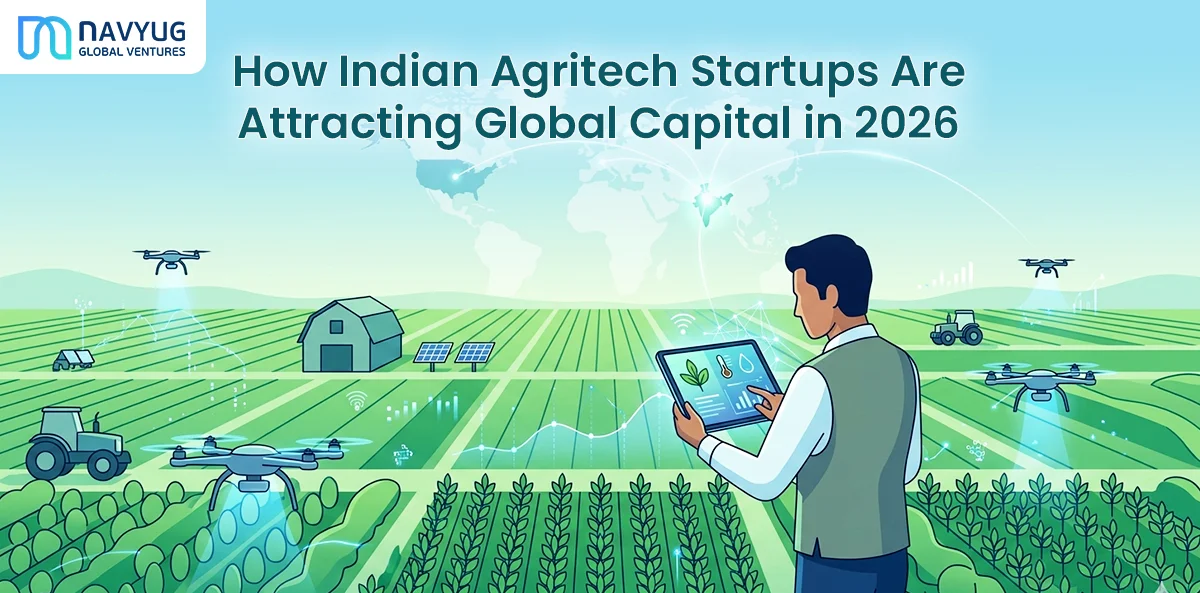
This evolution has made India into a global investment hotspot, attracting many venture capital interests across the Indian agritech ecosystem. The agritech fintech startups in India are helping farmers to use advanced agriculture technology by optimizing their supply chains. Investors see it as a strong scalability and long-term profitable impact. As a global investor looking for high-growth, impact-driven opportunities, Indian agriculture is improving itself as a major magnet for capital in 2026 and for the future.
Why Global Investors Are Pouring Capital Into Indian Agritech
Funding Milestones & Trends
Venture capital investments are being witnessed to grow tremendously in the agritech sector of India. According to industry reports, Indian agritech startups raised over $1 billion in early 2025, with approximately 35% year-on-year investor interest growth. The trend of growth has been going on since 2022, and it is projected to increase even more by 2026 due to the influx of global capital in the market. India is also very appealing to investors compared to other global trends because it is concerned with real farming issues at large scale.
Key Investment Hotspots
Investors are also targeting the high impact sectors in agritech. They are precision agriculture with the use of IoT, AI-powered farm advisory systems, and supply chain digitization with the direct connectivity of the farmers to the markets. Meanwhile, agri fintech startups are also on the rise offering simple credit and access to finance to farmers. Other sustainable agricultural methods such as platforms like CarbonX are helping farmers earn carbon credits for sustainable practices, attracting climate-focused VCs seeking both returns and environmental impact.
Why Global Investors Take Interest
The global investors are attracted to India as the country has a huge market (with more than 400 million farmers) and a high rate of adopting digital technologies. The ecosystem is also investor-friendly because of government assistance and conducive policies. Importantly, most of the agrotech startups are already performing well, also getting high returns on invested capital thus the sector is very suitable for venture capital investments.
Breakthrough Technologies Attracting Investment
Satellite & Remote Sensing
The top agriculture technology startups are satellite data, drones, IoT, and AI, to allow real-time monitoring of crops and predetermination of yield. Such sites as Farmonaut assist farmers to monitor the health of crops and make informed decisions based on the data which enhances productivity and efficiency.
AI & Machine Learning
The adoption of AI is massive with many startups incorporating it in their software. It allows regional advisory with a local language, weather prediction, risk management, and pest identification, which are among the important components of smart farming technology that increase the production in farms.
Blockchain & Traceability
Blockchain enhances supply chain visibility by facilitating farm-to-fork and quality control. It is also useful in the compliance of export requirements and thus worth investing in the startups that support agriculture technologies
IoT & Precision Farming
The IoT sensors and smart systems monitor the real-time conditions of soil, weather, and crops. Smart farming technology is reinforced by such technologies as smart irrigation, automated fertigation, and the ability to maximize resources through the use of technologies that improve precision farming.
Agri-Fintech Innovations
Indian agri fintech startups are changing rural finance with digital lending to farmers, satellite verification, weather insurance, and non-bank credit rating. The innovations are enhancing financial access by farmers and are getting robust investment attention.
How Government Support Is Catalyzing Agritech Investment
Policy Support
The Indian government highly encourages agritech development by organizing events such as Startup India, which has identified close to 2800 agritech startups from 31st December 2023. These startups enjoy tax exemptions, lax regulations and access to funds. Ecosystems such as e-NAM and Digital India initiatives are enhancing market access and are fueling digital agriculture India.
Funding Schemes
Programs such as the Agri Seed Funding Scheme offer up to 25 lakh to start-ups. Innovation and larger budgetary allocations in 20252026 have programs like the AgriTech Startup Grand Challenge and more venture capital pouring in.
Regulatory Framework
Streamlined drone policies, enhanced data protection regulations, and eased FDI standards are enabling startups to benefit and get foreign investments in the agritech sector.
Public-Private Partnerships
The partnership between government and private firms and research institutions is assisting start-ups to grow at an accelerated rate. These alliances facilitate innovation and the transfer of technology and practical application throughout the field of agriculture.
H2: How Agritech Startups Are Changing Indian Farming
Tangible Benefits
Agritech startups in India are assisting farmers to get up more yield and an increase in income. They also minimize risks by improving access to credit, insurance and clear prices in the market.
Sustainability Metrics
Smart farming technology allows farmers to save water and pesticides. The solutions are also beneficial in the health of the soil and are sustainable in farming.
Financial Inclusion
Agri fintech startups in India are enhancing digital loan access, crop insurance, and fair pricing, which decreases the reliance on middlemen and enhances the financial position of a farmer.
Scalability to Smallholder Farmers
Farming websites such as Farmonaut are targeting more than 200,000 farmers. These solutions are easy to scale due to mobile apps, support of the local language, and low prices.
Challenges Investors Face in Indian Agritech
Market Challenges
The Agritech startups India have challenges such as a lack of digital literacy, lack of trust between farmers, and rural infrastructures such as the internet. There are also data privacy issues that influence adoption.
Business Model Viability
Investors are interested in the possibility of profitability of start-ups. Venture capital firms are usually concerned with high costs of customer acquisition, poor customer retention and the lack of clear revenue models.
How Startups Overcome These
Effective startups employ mixed finances, pilot projects to gain confidence and establish collaborations with firms and government organizations. These are measures that can be used to enhance adoption and attract more venture capital investment.
Conclusion:
India has become the world leader in agritech startups, and the venture capital inflows and the increase in global capital interest are projected to grow to 2026. The agritech startups India ecosystem is enhancing the income of farmers, increasing the sustainability and transforming agriculture on a large scale due to innovation in smart farming technology, AI, and digital platforms. In the case of investors, this is a high growth prospect; in the case of entrepreneurs, a potential space with high untapped growth; and in the case of farmers, growth in terms of higher productivity and a diminishing risk. With government support, proven technology, and growing investor confidence, India’s agritech sector is positioned for sustained growth transforming both agriculture and rural prosperity across the country.Companies such as Navyug Global Ventures are taking a proactive role in this expansion making India not only a worry of a rapid follower, but also a trendsetter in agritech around the globe.
Frequently Asked Questions (FAQ)
What are agritech startups?
Why are agritech startups important in India?
They help solve major farming problems like low productivity, poor market access, and lack of finance, improving farmers’ income and efficiency.
What are the top agritech startups in India?
Some leading agritech startups include DeHaat, Ninjacart, AgroStar, and Farmonaut. These startups are supported by a mix of international and domestic venture capital firms focused on agriculture technology innovation.
How do agritech startups help farmers?
They provide better crop insights, access to markets, financial support, and modern tools that increase yield and reduce risks.
Why are investors interested in agritech startups?
They offer high growth potential, a large market, and strong impact, making them attractive for venture capital investment.
What role does government policy play in agritech growth?
Government initiatives like Startup India, e-NAM digital marketplace, and seed funding schemes (up to ₹25 lakh) are accelerating agritech adoption by reducing regulatory barriers and providing financial support to early-stage ventures.